Memories of a Lost Generation
This page is simply saying - you were here, you mattered, and we haven’t let you go
G. T. Harris — RAF Driver, Exeter
A Voice Preserved from a Lost Generation
🌿 Introduction
G. T. Harris arrived at RAF Exeter in May 1940, a young driver posted to an airfield that was still more civilian than military. He kept a diary — not for posterity, not for publication, but simply to record what he saw, felt, and endured. His notes capture the earliest days of the RAF at Exeter with a clarity that official histories rarely achieve.
These fragments are among the few surviving first‑hand accounts of life on the station in 1940. They reveal the improvisation, the humour, the fear, and the humanity of men who found themselves building defences one moment and facing the consequences of Dunkirk the next.
Harris’s words are presented here exactly as he wrote them. Nothing altered. Nothing embellished. They stand as a testament to an ordinary airman whose quiet observations now speak for a generation that is slipping beyond living memory.
📜 Why His Story Matters
- He offers a ground‑level view of RAF Exeter before it became a fully operational wartime station.
- His diary captures the emotional landscape of 1940: uncertainty, camaraderie, exhaustion, and resilience.
- He records the atmosphere of Exeter itself — a city still bright and unscarred, unaware of what lay ahead.
- His voice is unfiltered, honest, and deeply human.
In preserving his words, we honour not only Harris but the thousands like him whose stories were never formally recorded.
🌤️ A Note on Presentation
The diary entries below appear exactly as Harris wrote them. Spelling, punctuation, and phrasing are unchanged. They are accompanied only by light contextual notes to help modern readers understand the setting and significance of each moment.
The first few months of the war at Exeter Airfield was historically captured in the form of diary notes by G T Harris. He worked in the MT section as a driver. Harris arrived on 23 May 1940 and wrote in his diary, ‘the station at Exeter is a place that was previously used as a civil airport. There are no beds but otherwise it was well equipped. I slept on a wood-blocked floor with a ground sheet, a few old newspapers and four blankets.’
When the RAF first arrived in June and July 1940, the only building was the first phase of the terminal building which was used by the Aero Club in short time before the war started. Ground crews were billeted in bell tents and the pilots and officers were lucky enough to stay in Exeter and the surrounding area hotels and mansion houses.
The following day Harris wrote ‘a lorry arrives with pickaxes and shovels. Soon we are filling sandbags. This done we threw up earthworks, a machine gun will be mounted in the centre. All over the drone similar posts are being built. It is quite a novel sight to see the RAF in their shirt sleeves doing some work. A flight Lieutenant who earlier in the day had been doing practice dive bombing at 300 mph with a fairey battle is swinging a pickaxe.’
Main source Exeter Remembers The War – Life on the Home Front p20-21 – Todd Gray.
From a series of notes from the diary of G T Harris, RAF Driver, Exeter.
Three days later, 26 May 1940, Harris wrote in his diary, ‘In the evening I go to Exeter. People stare curiously, for down this way the war is still far away and it is not usual to see a man armed. As everywhere in England the women are smart, but in Exeter possessing more than average good looks. The atmosphere in the city is bright and friendly. Cheerfulness everywhere, one day I shall visit Exeter in peacetime.’
Main source Exeter Remembers The War – Life on the Home Front p21 – Todd Gray.
Imperial War Museum (IWM).
From a series of notes from the diary of G T Harris, RAF Driver, Exeter.
Continuing the notes from G T Harris, RAF diary during the war, it is interesting that some of the pages from his time in Exeter were torn out. He was a driver in the RAF and wrote on the 31 May, ‘Exeter is packed with troops from the Flanders coast. Some of them have no more that they walk in, dirty uniforms, tin helmets. Here and there is an occasional French officer. Where’s the Air Force been? Is the cry hurled at us in the street. It isn’t any fault of ours. Go see the Air Ministry I reply truculently to one fellow in the fish shop. Seeing I am not taking it lying down the soldier becomes apologetic and hastens to assure us that of course the ordinary airmen had nothing to do with the scanty air support on the Western Front.’
Main source Exeter Remembers The War – Life on the Home Front p26 – Todd Gray.
Devon Record Office, Town Clerk’s papers.
From a series of notes from the diary of G T Harris, RAF Driver, Exeter.
Rumours were rife about the fact Germans were invading the British shores particularly Budleigh Salterton, Exmouth and Sidmouth. Washed up bodies were being confused as the enemy when in fact they were the sad evidence of something that had gone badly wrong in Slapton, South Devon. The bodies were all Americans. Perhaps the most striking example was recorded by G T Harris, a driver with the RAF, who was on duty at the airport in May 1940. He wrote in his diary after one night, ‘in the guardroom we are given a lecture by the CO who is evidently three sheets to the wind. Unidentified aircraft have been seen flying near the camp. There are wild rumours of parachute troops, thousands, landing near Folkstone. Shoot says the CO, shoot to kill. We wander around the camp in a daze. Cold dawn is perceptively lighting the darkness. Black figures on the horizon which appear to advance towards me become visible as short stumpy trees.’
Samuel Green Fenwick – The Airman Who Slipped Quietly From View
601 Squadron, RAF Died 2007 – Buried Somewhere in Devon
Some stories from the wartime generation end with a flourish of detail, a headstone, a parish record, a place where memory can settle. Others fade into softer outlines, leaving only the man, his service, and a lingering question. Samuel Green Fenwick belongs to the latter.
Fenwick served with 601 Squadron, the famed “Millionaires’ Squadron”, a unit known for its style, swagger, and fierce fighting spirit. Like so many of his generation, he survived the war, built a life in the peace that followed, and eventually found his way to Devon — a county that has quietly welcomed more than a few RAF men into its soil.
When he died in 2007, records confirm that he was buried in Devon. And yet, no cemetery register, no parish ledger, no headstone, and no digitised archive reveals where he lies. His final resting place remains unmarked in the public record — a private farewell, a family decision, or simply a detail lost in the quiet shuffle of time.
What remains is the man himself:
An RAF airman of a storied squadron
A survivor of the war’s most turbulent years
Someone who chose Devon as his final home
And now, a small mystery: a burial known, but a grave unseen.
For the historian, it’s a loose thread. For the storyteller, it’s a whisper of intrigue. For the community, it’s a reminder that not every hero leaves a signpost behind.
But for Fenwick, perhaps this was exactly as he wished — a peaceful return to the county he chose, without fanfare, without ceremony, just a quiet place somewhere in Devon where an old airman rests.
"Their names are spoken, their stories are preserved, and their memory has a home"
Memories of a Lost Generation
This page is simply saying - you were here, you mattered, and we haven’t let you go
Samuel Green Fenwick – The Airman Who Slipped Quietly From View
601 Squadron, RAF Died 2007 – Buried Somewhere in Devon
Some stories from the wartime generation end with a flourish of detail, a headstone, a parish record, a place where memory can settle. Others fade into softer outlines, leaving only the man, his service, and a lingering question. Samuel Green Fenwick belongs to the latter.
Fenwick served with 601 Squadron, the famed “Millionaires’ Squadron”, a unit known for its style, swagger, and fierce fighting spirit. Like so many of his generation, he survived the war, built a life in the peace that followed, and eventually found his way to Devon — a county that has quietly welcomed more than a few RAF men into its soil.
When he died in 2007, records confirm that he was buried in Devon. And yet, no cemetery register, no parish ledger, no headstone, and no digitised archive reveals where he lies. His final resting place remains unmarked in the public record — a private farewell, a family decision, or simply a detail lost in the quiet shuffle of time.
What remains is the man himself:
An RAF airman of a storied squadron
A survivor of the war’s most turbulent years
Someone who chose Devon as his final home
And now, a small mystery: a burial known, but a grave unseen.
For the historian, it’s a loose thread. For the storyteller, it’s a whisper of intrigue. For the community, it’s a reminder that not every hero leaves a signpost behind.
But for Fenwick, perhaps this was exactly as he wished — a peaceful return to the county he chose, without fanfare, without ceremony, just a quiet place somewhere in Devon where an old airman rests.
"Their names are spoken, their stories are preserved, and their memory has a home"
Memories of a Lost Generation
This page is simply saying - you were here, you mattered, and we haven’t let you go
Samuel Green Fenwick – The Airman Who Slipped Quietly From View
601 Squadron, RAF Died 2007 – Buried Somewhere in Devon
Some stories from the wartime generation end with a flourish of detail, a headstone, a parish record, a place where memory can settle. Others fade into softer outlines, leaving only the man, his service, and a lingering question. Samuel Green Fenwick belongs to the latter.
Fenwick served with 601 Squadron, the famed “Millionaires’ Squadron”, a unit known for its style, swagger, and fierce fighting spirit. Like so many of his generation, he survived the war, built a life in the peace that followed, and eventually found his way to Devon — a county that has quietly welcomed more than a few RAF men into its soil.
When he died in 2007, records confirm that he was buried in Devon. And yet, no cemetery register, no parish ledger, no headstone, and no digitised archive reveals where he lies. His final resting place remains unmarked in the public record — a private farewell, a family decision, or simply a detail lost in the quiet shuffle of time.
What remains is the man himself:
An RAF airman of a storied squadron
A survivor of the war’s most turbulent years
Someone who chose Devon as his final home
And now, a small mystery: a burial known, but a grave unseen.
For the historian, it’s a loose thread. For the storyteller, it’s a whisper of intrigue. For the community, it’s a reminder that not every hero leaves a signpost behind.
But for Fenwick, perhaps this was exactly as he wished — a peaceful return to the county he chose, without fanfare, without ceremony, just a quiet place somewhere in Devon where an old airman rests.
"Their names are spoken, their stories are preserved, and their memory has a home"
Memories of a Lost Generation
This page is simply saying - you were here, you mattered, and we haven’t let you go
Samuel Green Fenwick – The Airman Who Slipped Quietly From View
601 Squadron, RAF Died 2007 – Buried Somewhere in Devon
Air Commodore William “Billy” Drake CBE, DSO, DFC & Bar
1917–2011 A Legend of the RAF Whose Final Resting Place Remains Unknown
Some men leave such a vivid imprint on the RAF’s story that their names feel woven into the fabric of its history. William “Billy” Drake was one of them — a fighter ace, a natural leader, and one of the most colourful personalities to emerge from the wartime air force. Yet, in a twist that feels almost at odds with the scale of his life, the details of his final resting place have slipped quietly from view.
Drake died in Teignmouth, Devon, in 2011, leaving behind two sons and a legacy that stretched from the Battle of France to the Western Desert and beyond. Locals in Bishopsteignton remember him well — the distinguished gentleman with the unmistakable presence, the war stories delivered with a twinkle, the sense of history carried lightly on his shoulders.
And yet, despite his prominence, no parish register, cemetery ledger, or crematorium record in the Teignbridge area reveals where he was laid to rest. Your own research through local parishes and crematoria has confirmed the same silence. For a man so publicly celebrated, the absence of a recorded grave is striking.
It leaves us with possibilities rather than answers:
A private family burial, unmarked by request
A cremation with ashes scattered somewhere meaningful
A woodland or private land interment outside parish systems
Or simply a record that was never digitised, never shared, or quietly misfiled
Whatever the reason, the result is the same: Billy Drake, one of the RAF’s most decorated and charismatic wartime pilots, has no publicly known resting place in the county where he spent his final years.
What remains is the man — and what a man he was:
A fighter ace with victories across multiple theatres
A leader whose pilots trusted him implicitly
A raconteur, a gentleman, and a familiar face in Bishopsteignton
A link to a generation whose stories shaped the world we inherited
And now, like a final footnote to a life lived at full throttle, a small mystery: a hero remembered vividly in life, yet untraceable in death.
Perhaps that is fitting in its own way. Billy Drake spent his wartime years slipping through danger with skill and instinct. In the end, he slipped quietly from the record too — leaving only memory, legacy, and the echoes of a remarkable life lived.
"their presence still echoes".
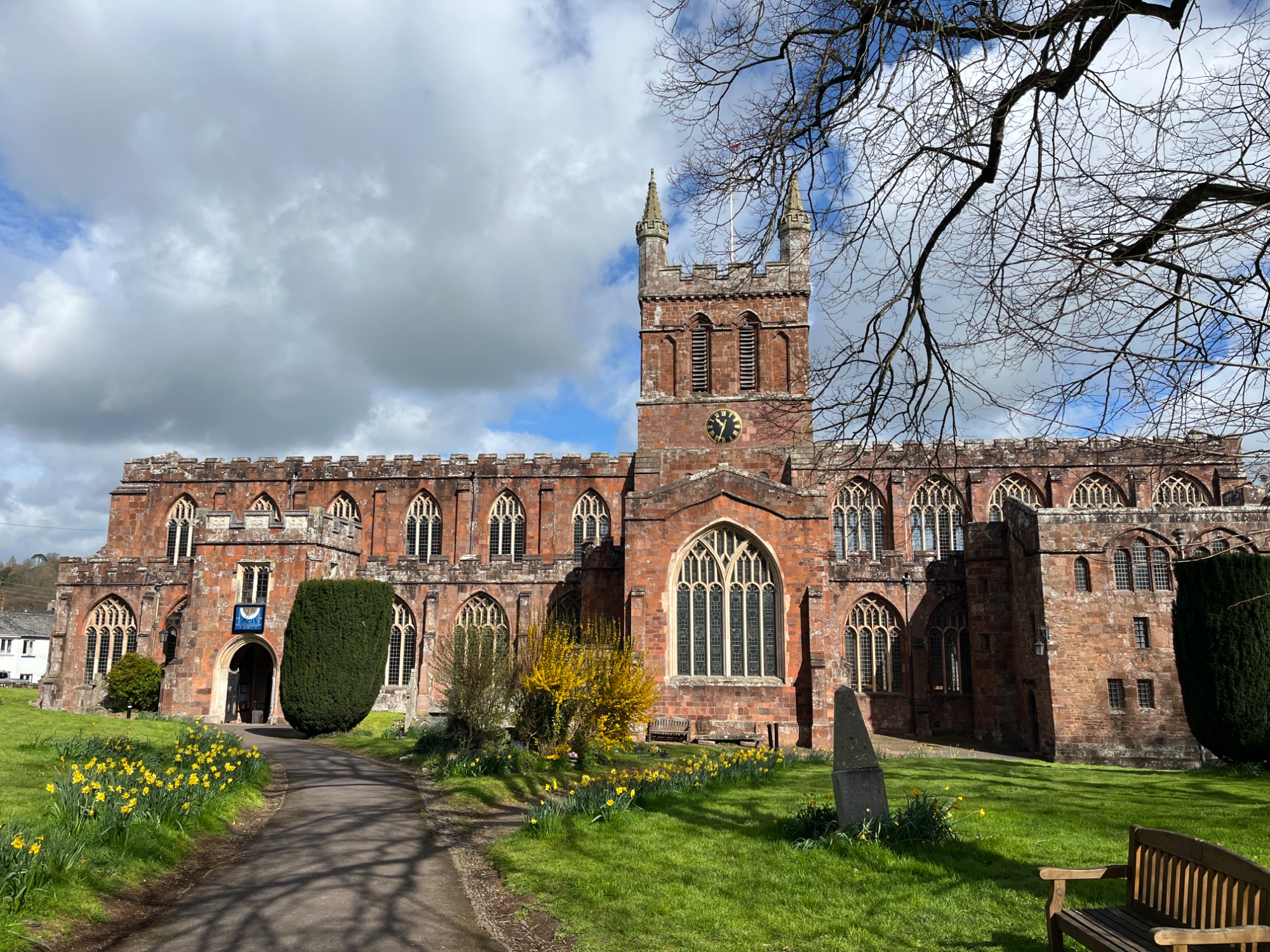
THE HUGO BROTHERS OF CREDITON
Two sons, two airmen, two losses — both aged 21
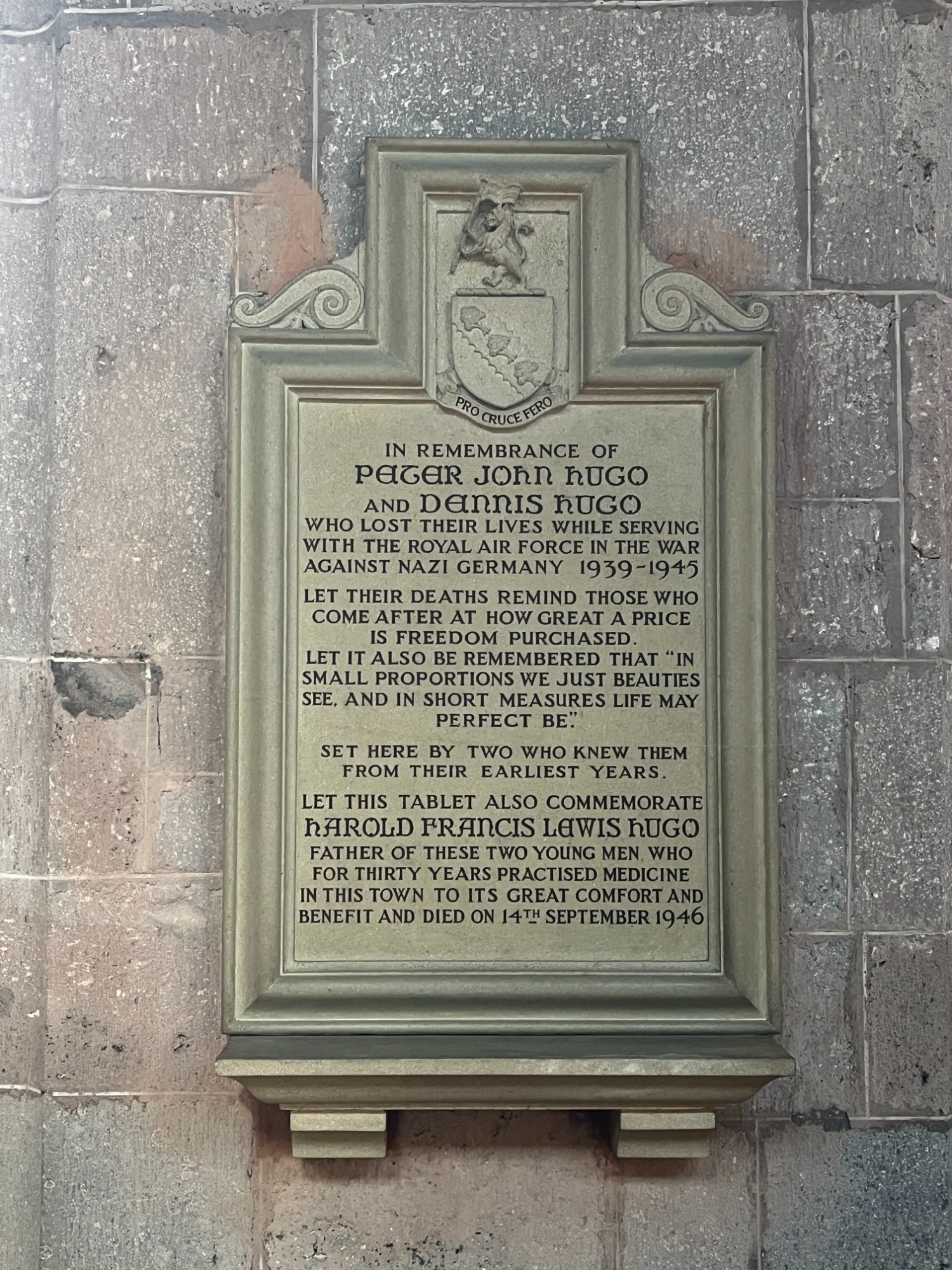
The story of the Hugo brothers is one of the most poignant wartime narratives to emerge from Crediton. Sons of Dr Harold F. L. Hugo and F. Bessie Hugo, both young men served with the Royal Air Force Volunteer Reserve, and both were lost in the service of their country before their lives had truly begun.
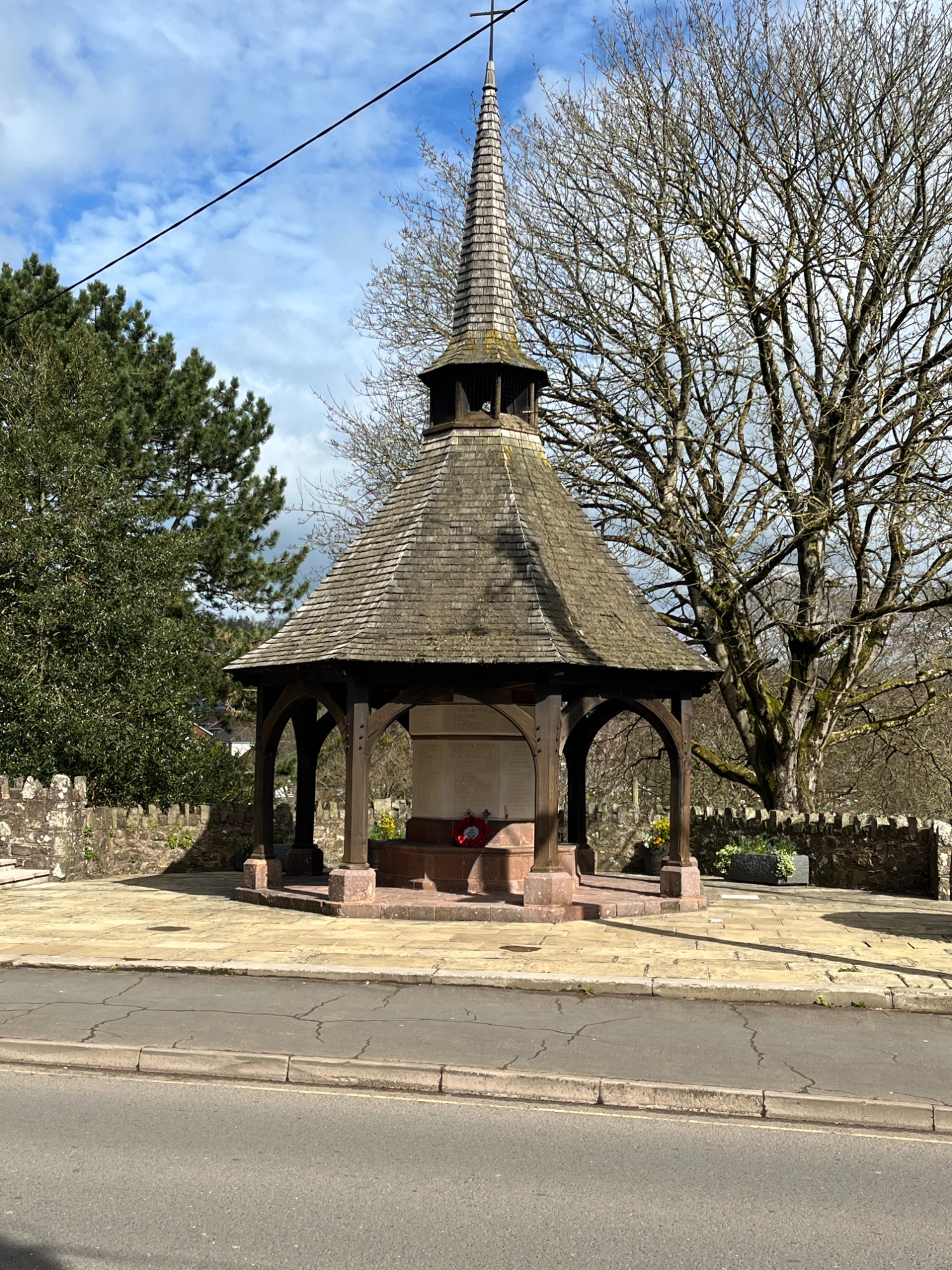
Their names stand together on the central Crediton war memorial — a lasting reminder of the family’s sacrifice and the impact felt across the town.
Though their RAF paths were different, their stories share the same threads of youth, promise, and devotion to duty. Their individual accounts can be read below.
Navigation
• Flying Officer Peter John Hugo — 540 Squadron (Mosquito) • Pilot Officer Dennis Harold Hugo — 66 Squadron (Spitfire)
FLYING OFFICER PETER JOHN HUGO
122131 · Royal Air Force Volunteer Reserve Died 8 January 1944 · Aged 21 540 Squadron · de Havilland Mosquito Pilot Buried at Benson (St Helen) Churchyard Extension · Row G, Grave 11
Flying Officer Peter John Hugo was the elder of the two Hugo brothers of Crediton. He served with No. 540 Squadron, a specialist photographic‑reconnaissance unit flying the de Havilland Mosquito — unarmed, high‑altitude aircraft whose intelligence‑gathering missions were vital to Allied planning.
On 8 January 1944, Peter was flying Mosquito LR407 when the aircraft suffered an engine failure on approach to RAF Benson. With insufficient height to recover, the aircraft stalled and crashed half a mile north of the airfield. Peter was killed in the accident.
He was 21 years old, and is buried at Benson (St Helen) Churchyard Extension, close to the airfield from which he served.
Peter’s work placed him among the RAF’s most skilled and quietly courageous airmen. His loss, followed fifteen months later by that of his younger brother, was deeply felt in Crediton.
PILOT OFFICER DENNIS HAROLD HUGO
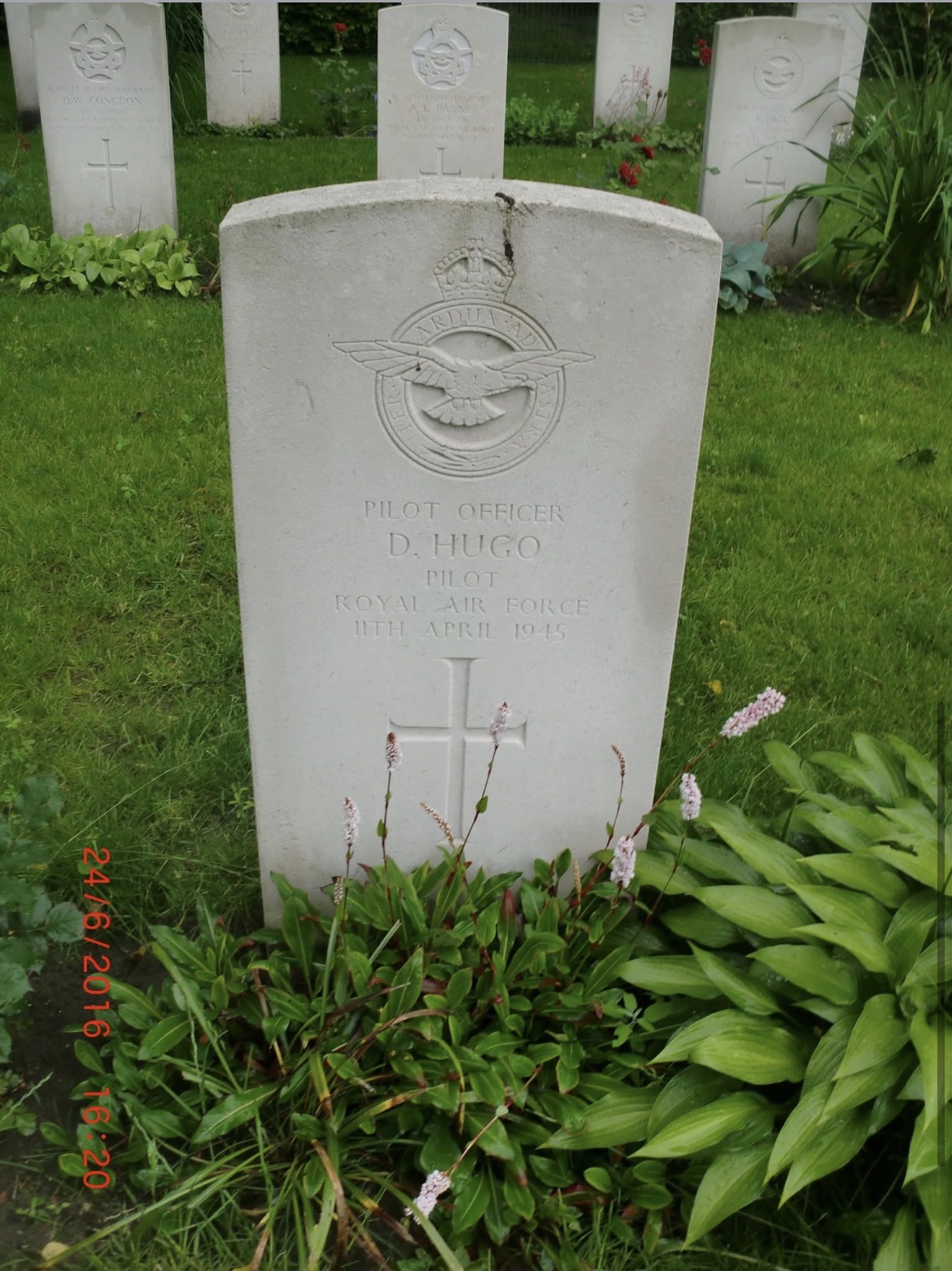
187677 · Royal Air Force Volunteer Reserve Died 11 April 1945 · Aged 21 66 Squadron · Spitfire Pilot Buried at Sage War Cemetery, Germany
Pilot Officer Dennis Harold Hugo was educated at Oxford University, where he joined the University Air Squadron and learned to fly. He later served with No. 66 Squadron, a fighter unit that spent periods operating from RAF Exeter, giving Dennis a direct connection to the airfield’s wartime story.
Dennis flew Supermarine Spitfire TB752, becoming the fourth and final wartime pilot to fly the aircraft — a rare distinction, as TB752 survives today as one of the most significant late‑war Spitfires.
On 11 April 1945, during operations over Germany in the final month of the war, Dennis was killed. He is buried at Sage War Cemetery, where his headstone bears the simple inscription:
PILOT OFFICER D. HUGO PILOT ROYAL AIR FORCE 11TH APRIL 1945
His loss, coming so soon after Peter’s, marked a profound tragedy for the Hugo family and for the town of Crediton.
Closing Note
Together, Peter and Dennis represent the deeply human side of wartime service — two young men from a Devon town, each serving in demanding roles, each lost at twenty‑one. Their stories, preserved here, form an important part of both Crediton’s memory and the RAF Exeter narrative.
Two Polish Airmen Buried in Exeter
Lest We Forget.
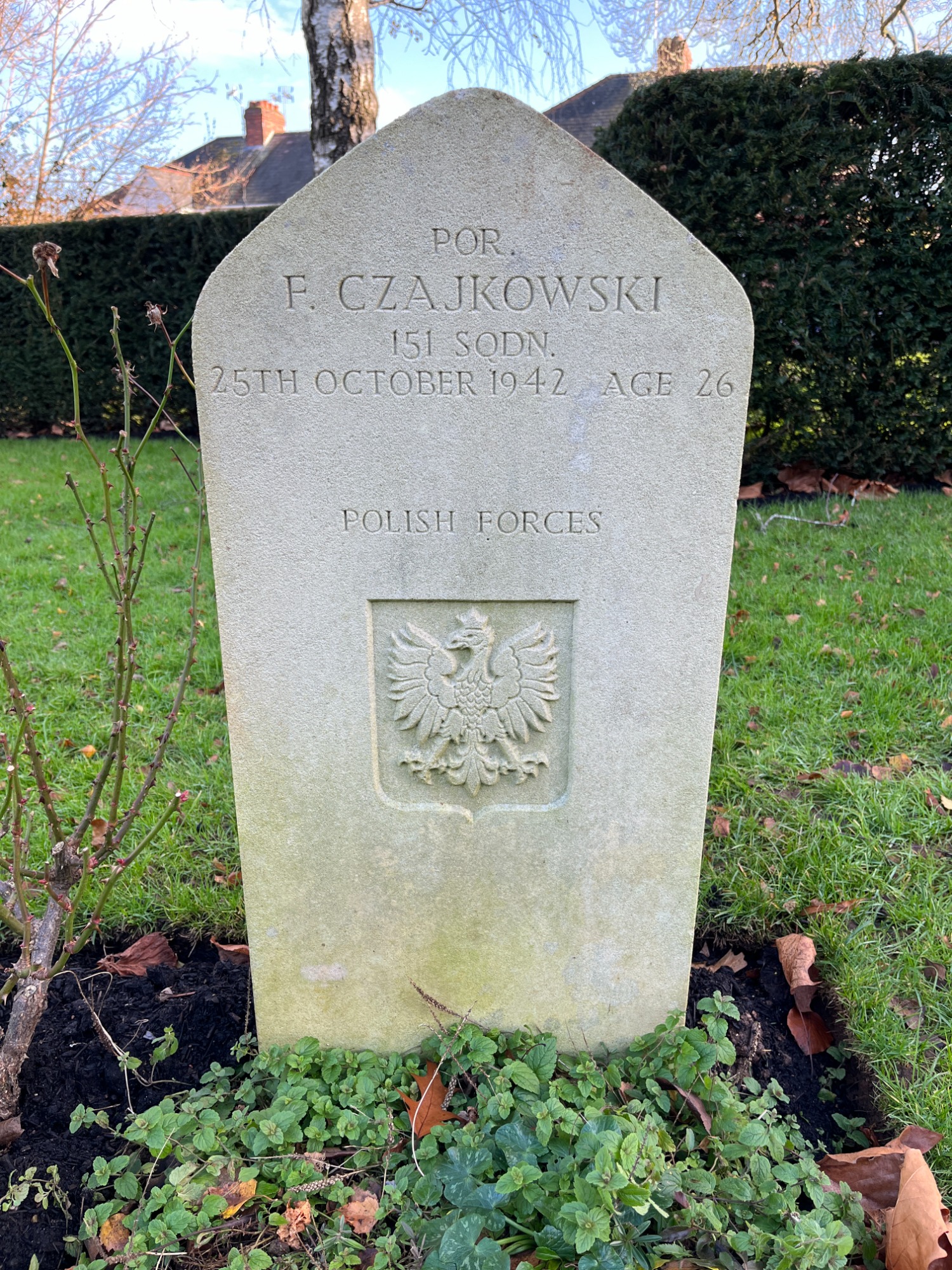
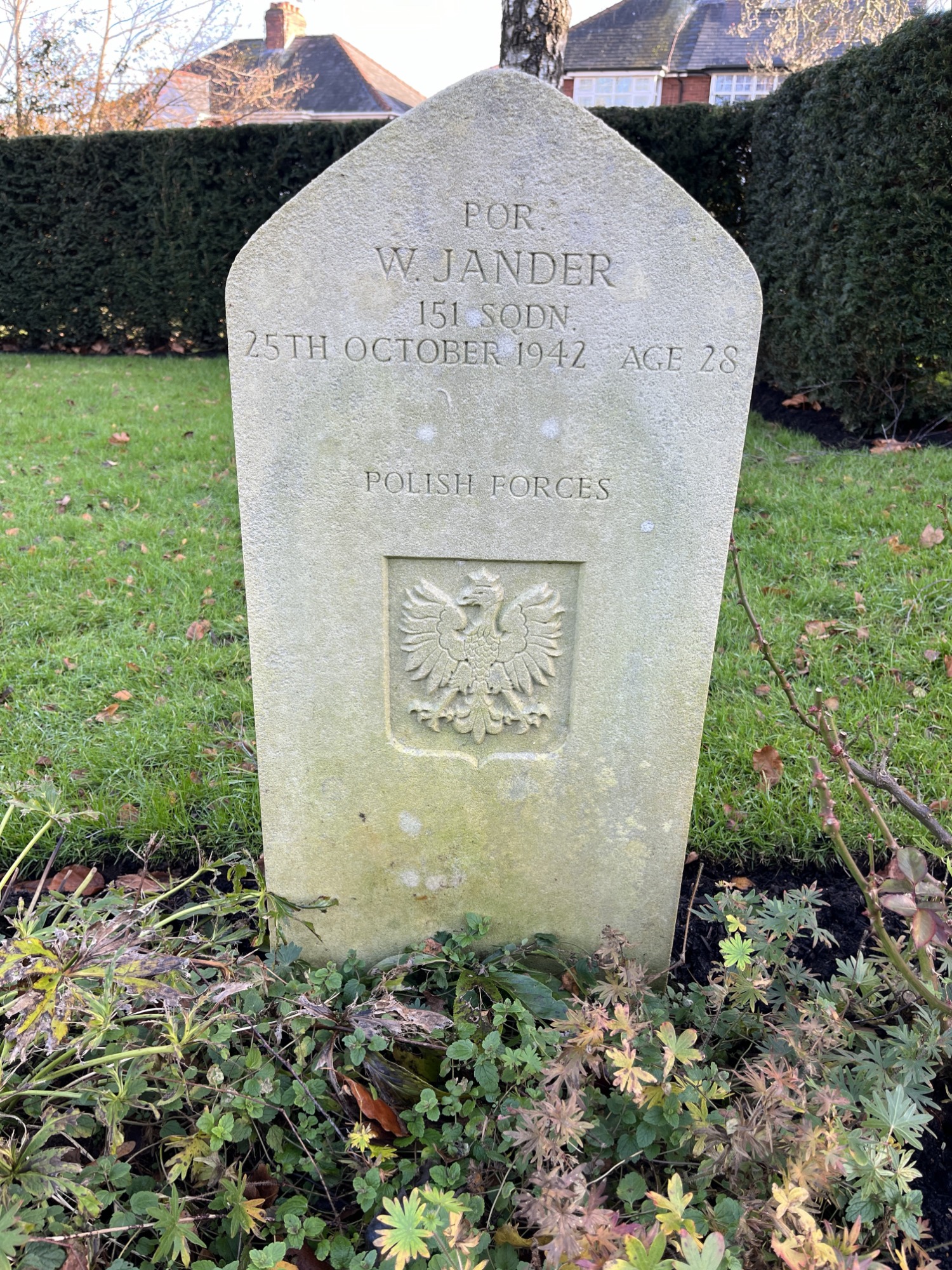
Although 151 Squadron was not officially based at RAF Exeter until after the war in 1945, the unit holds a poignant and little‑known connection with the Southwest. In 1942, two Polish pilots serving with the Squadron—Pilot Officer F. Czajkowski, born in Poland on 20 September 1916, and W. Jander, born on 15 December 1913—were recovering from injuries at the RAF Hospital in Torquay. At that time, the hospital operated from the former Palace Hotel, which had been requisitioned for wartime medical use.
Tragically, on 25 October 1942, the hotel was attacked during an enemy air raid. The bombing caused severe destruction and resulted in numerous casualties among staff, patients, and service personnel. Among those killed were the two Polish pilots, who had already endured so much in service of the Allied cause.
Today, Pilot Officer Czajkowski and Pilot Officer Jander lie side by side in the Second World War plot at Exeter Higher Cemetery, their graves maintained by the Commonwealth War Graves Commission. Their resting place stands as a quiet reminder of the international sacrifice woven into Exeter’s wartime story.
151 Squadron itself was a highly mobile unit, operating from no fewer than 26 different locations across the United Kingdom—and earlier, France—before eventually moving north to Scotland. At the time of the Torquay bombing, the Squadron was based at RAF Wittering, with a detachment operating from RAF Coltishall. Despite the distance, the loss of the two Polish airmen remains part of the Squadron’s wider legacy and its unexpected link to Devon.
Page last updated 8 April 2026.